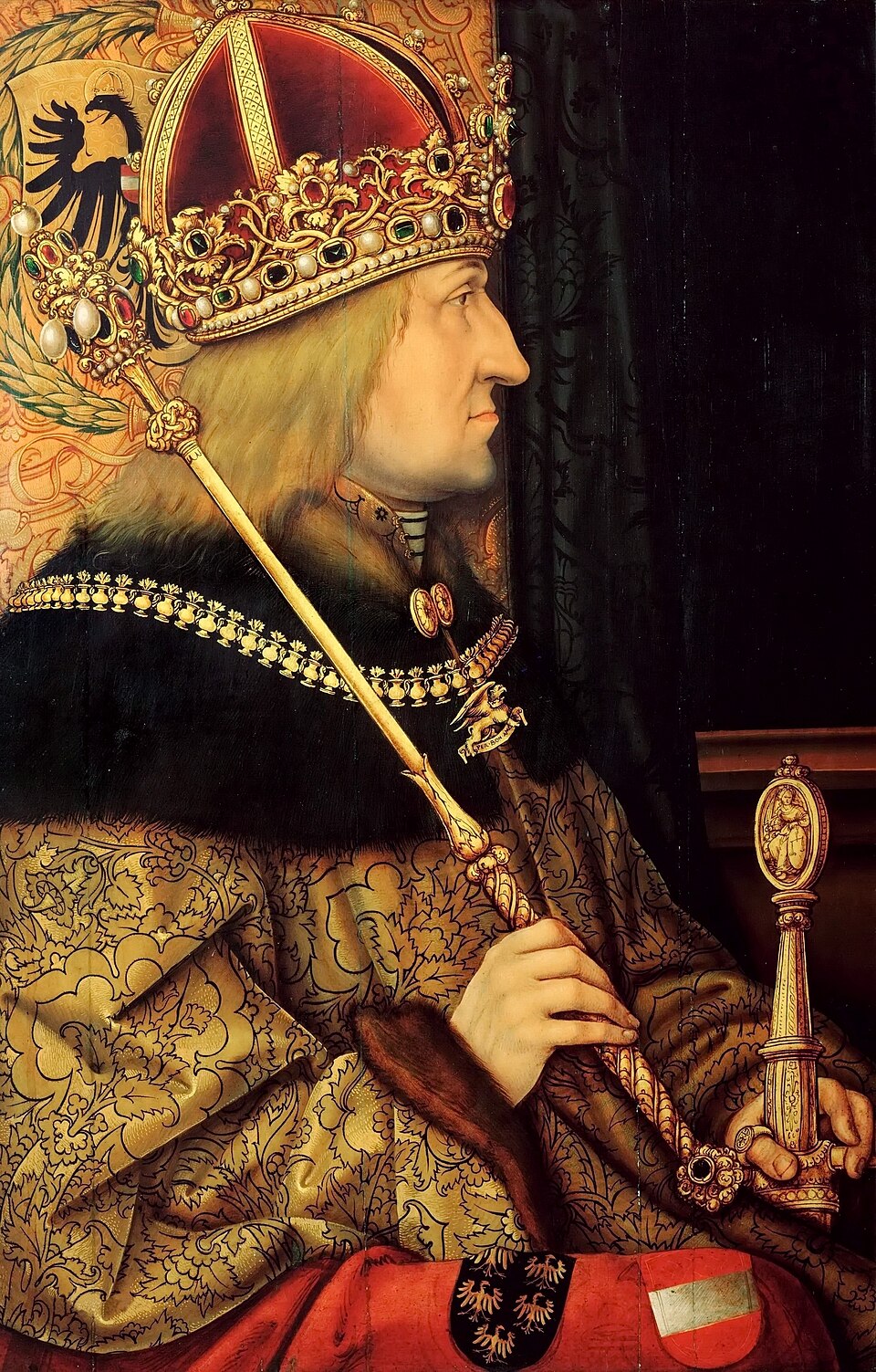
Frederick III
Friedrich III.
Holy Roman Emperor · King of Germany · Archduke of Austria
1415 – 1493
- Born
- 1415
- Died
- 1493
- Reign
- 1452 – 1493
- House
- Austrian Habsburgs
Biography
Few medieval rulers reigned as long, or were as frequently written off by contemporaries, as Frederick III, who headed the Holy Roman Empire for more than half a century. Born in 1415 at Innsbruck to Duke Ernest of the Leopoldine Habsburg line and Cymburgis of Masovia, a princess of the Polish Piast dynasty, he became Duke of Inner Austria as a boy and was elected King of the Romans in 1440. In 1452 he traveled to Rome and was crowned emperor by Pope Nicholas V, the last imperial coronation ever performed in that city.
On the same Roman journey Frederick married Eleanor of Portugal, daughter of King Duarte of the house of Aviz, a match that brought a substantial dowry and connected the Habsburgs to the Iberian world two generations before their better-known Spanish alliances. The marriage produced Maximilian, the son on whom Frederick's dynastic hopes came to rest.
Frederick's reign was marked by chronic weakness in practice. He struggled against rebellious estates, against his own Habsburg relatives in protracted disputes over the family lands, and against Matthias Corvinus of Hungary, who conquered much of Lower Austria and occupied Vienna itself in 1485, forcing the emperor into years of itinerant residence. Yet Frederick was a patient and stubborn dynast. In 1477 he concluded the marriage of Maximilian to Mary of Burgundy, heiress of Charles the Bold, which brought the Burgundian Netherlands into the Habsburg inheritance and laid the groundwork for the dynasty's later position as a European great power. He is associated with the device AEIOU, which he inscribed on his possessions and which later generations read as a prophecy of Austrian greatness.
He also secured the election of Maximilian as King of the Romans in 1486, ensuring an orderly succession, and lived to see Matthias Corvinus die and the lost Austrian lands recovered. Frederick died at Linz in 1493, after a reign of forty-one years as emperor, and was buried in St. Stephen's Cathedral in Vienna in an elaborate tomb that had been decades in the making. His persistence, rather than any single achievement, transformed the Habsburgs from one princely family among many into the empire's quasi-hereditary ruling house.
Updated June 2026 · How we research
Connections across houses
Place Frederick III in the wider world of ruling houses.
Recommended Reading
Affiliate disclosure: the links below go to Amazon searches. As an Amazon Associate, Dynastica earns from qualifying purchases.