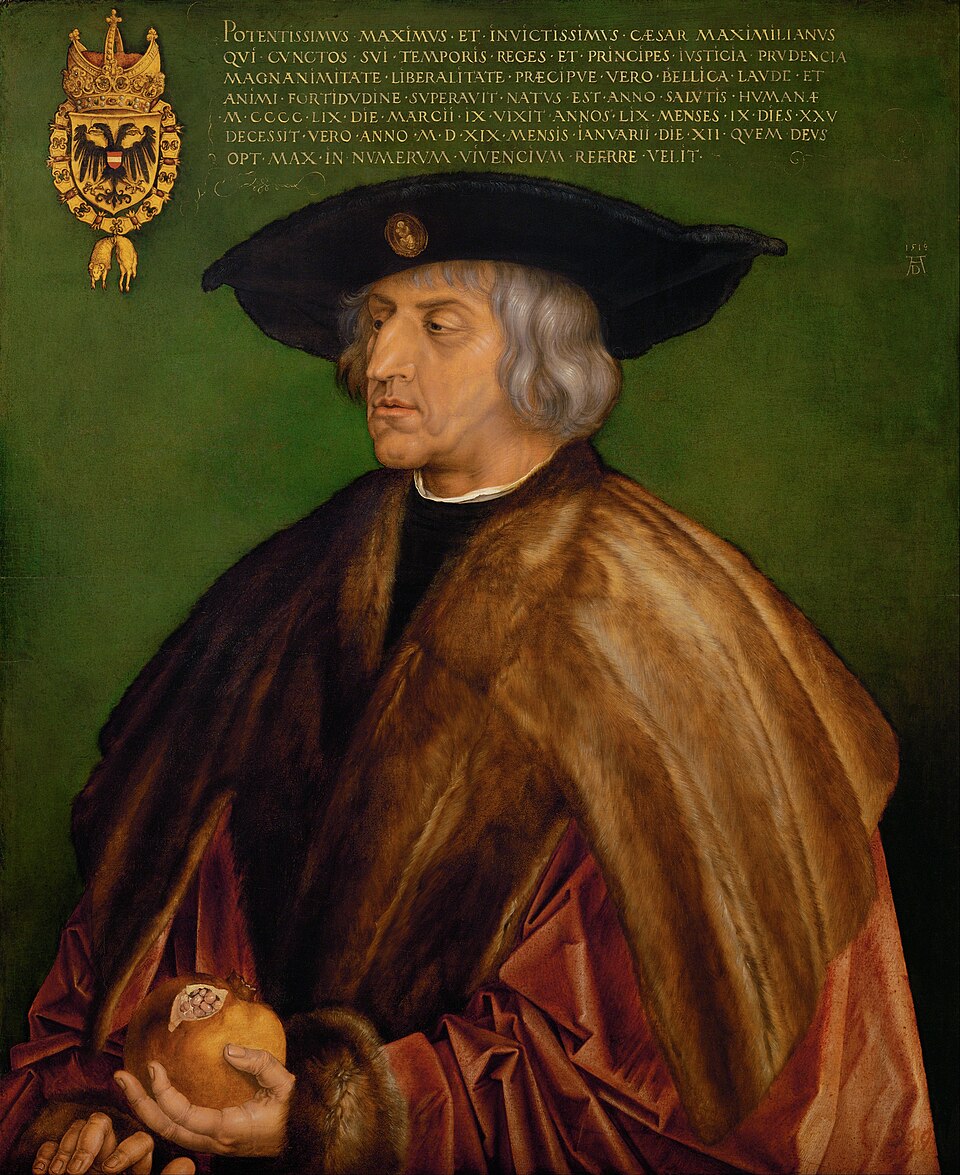
Maximilian I
Maximilian I.
Holy Roman Emperor · King of Germany · Archduke of Austria · Duke of Burgundy (jure uxoris)
1459 – 1519
- Born
- 1459
- Died
- 1519
- Reign
- 1508 – 1519
- House
- Austrian Habsburgs
Biography
Maximilian I (1459-1519) transformed the Habsburgs from a regionally important Austrian house into a dynasty with claims across western Europe, chiefly through marriage rather than conquest. The son of Emperor Frederick III and Eleanor of Portugal, he was born at Wiener Neustadt and grew up during the lean final decades of his father's long reign.
His own marriage in 1477 to Mary of Burgundy, heiress of Charles the Bold, brought the Habsburgs the Burgundian inheritance: the Low Countries and Franche-Comté, among the wealthiest territories in Europe. Mary's death in a riding accident in 1482 left Maximilian to defend these lands as regent for their young son, Philip the Handsome, against French claims and against the resistance of the Netherlandish towns themselves. Elected King of the Romans in 1486, he succeeded his father as head of the house in 1493 and in 1508, unable to reach Rome for a papal coronation, assumed the title of Elected Roman Emperor with papal consent, a precedent his successors followed.
Within the Empire, Maximilian presided over the reform efforts of the 1495 Diet of Worms, which proclaimed a perpetual public peace and created the Imperial Chamber Court. His foreign policy was dominated by intermittent war with France over Burgundy and Italy, conducted on chronically inadequate finances. More durable than his campaigns was his dynastic planning. The double marriage of 1496-97 joined his children Philip and Margaret to Juana and Juan of the Spanish house of Trastámara, the children of Ferdinand of Aragon and Isabella of Castile. A series of deaths in the Spanish line made Juana heiress of Castile, so that Maximilian's grandsons Charles and Ferdinand stood to inherit both the Spanish kingdoms and the Austrian lands. A second double marriage, arranged with the Jagiellon dynasty at Vienna in 1515, paired his grandchildren Ferdinand and Mary with Anna and Louis of Hungary and Bohemia, preparing the Habsburg acquisition of those crowns after 1526.
Maximilian also cultivated his own commemoration, sponsoring genealogical works, printed monuments, and semi-autobiographical writings such as the Weisskunig. He died at Wels in Upper Austria in January 1519. His grandson Charles V succeeded him as emperor, inheriting an accumulation of crowns that no Habsburg ruler before him could have imagined; the eventual division of that inheritance between Charles and his brother Ferdinand created the Spanish and Austrian branches that defined the dynasty for two centuries.
Updated June 2026 · How we research
Connections across houses
Place Maximilian I in the wider world of ruling houses.
Recommended Reading
Affiliate disclosure: the links below go to Amazon searches. As an Amazon Associate, Dynastica earns from qualifying purchases.