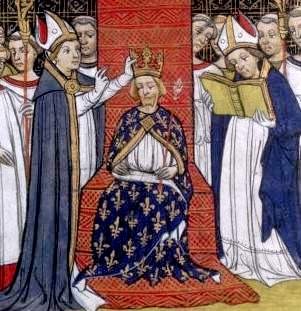
Philip III
Philippe III le Hardi
King of France
1245 – 1285
- Born
- 1245
- Died
- 1285
- Reign
- 1270 – 1285
- House
- Capetian
Biography
Philip III inherited the crown in a crusader camp. The second son of Louis IX and Margaret of Provence, he became heir on the death of his elder brother Louis in 1260, and he was with his father at Tunis in August 1270 when the king died during the Eighth Crusade. Proclaimed king in North Africa, Philip conducted a sombre return journey to France marked by further family deaths, including that of his first wife, Isabella of Aragon, following an accident in Calabria in 1271. He was crowned at Reims later that year.
The reign brought a major enlargement of the royal domain. When Philip's uncle Alphonse of Poitiers and his wife Joan of Toulouse died childless in 1271, their vast inheritance, including the county of Toulouse, reverted to the crown, completing the absorption of Languedoc begun under Louis VIII. Philip also continued his father's administrative practices, relying on established royal officials; contemporaries noted his deference to counselors, among them, for a time, the chamberlain Pierre de la Broce, who ultimately fell from favor and was executed.
Family alliances shaped his foreign policy. By Isabella of Aragon he had several sons, including the future Philip IV; in 1274 he married Marie of Brabant. His sister-in-law's inheritance brought a French claim to the county of Champagne's neighbor Navarre into the family orbit when his son Philip was betrothed to Joan, heiress of Navarre and Champagne, a union concluded in 1284 that later joined both territories to the French crown.
The reign ended in a disastrous foreign adventure. After the Sicilian Vespers of 1282 expelled the forces of Philip's uncle, Charles of Anjou, from Sicily, the papacy declared a crusade against the responsible party, King Peter III of Aragon, and offered the Aragonese crown to Philip's younger son. The resulting Aragonese Crusade of 1285 collapsed amid disease and a naval defeat. Retreating across the Pyrenees, Philip died of dysentery at Perpignan in October 1285. He was succeeded by Philip IV, under whom the monarchy turned from crusading ventures to harder-edged statecraft.
Updated June 2026 · How we research
Connections across houses
Place Philip III in the wider world of ruling houses.
Recommended Reading
Affiliate disclosure: the links below go to Amazon searches. As an Amazon Associate, Dynastica earns from qualifying purchases.