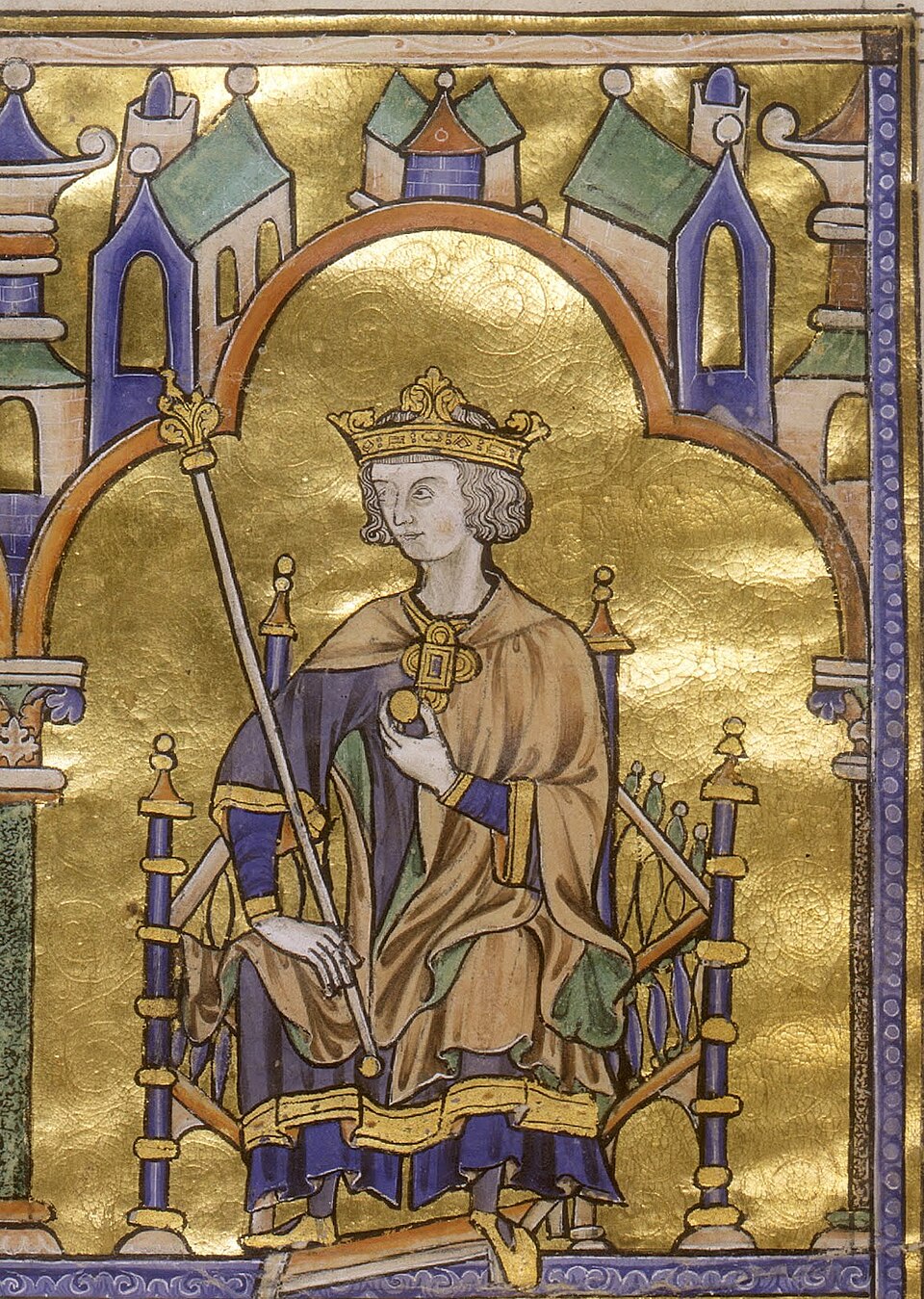
Louis IX
Louis IX
King of France
1214 – 1270
- Born
- 1214
- Died
- 1270
- Reign
- 1226 – 1270
- House
- Capetian
Biography
Canonized in 1297, Louis IX is the only king of France to have been declared a saint, and his reign became the standard against which later French kingship was measured. Born at Poissy in 1214, he was the son of the future Louis VIII and Blanche of Castile, herself a granddaughter of Henry II of England and Eleanor of Aquitaine. His father died in 1226 after a reign of three years, leaving the twelve-year-old Louis as king; his mother governed as regent, defeating a series of baronial coalitions and preserving the crown's position until her son assumed personal rule.
In 1234 Louis married Margaret of Provence, eldest of the four daughters of Count Raymond Berengar V. Her sister Eleanor married Henry III of England, making the kings of France and England brothers-in-law, a connection that later eased their negotiations. The marriage produced eleven children, among them the future Philip III.
Louis took the crusader's vow after a grave illness in 1244 and led the Seventh Crusade to Egypt in 1248. After the capture of Damietta the campaign ended in disaster: the king was taken prisoner in 1250 during the retreat from Mansurah and released only after the surrender of Damietta and payment of a large ransom. He remained in the Latin East until 1254, strengthening the fortifications of the crusader ports, while Blanche of Castile again governed France until her death in 1252.
At home Louis acquired a reputation for justice that extended beyond his borders. He dispatched investigators to hear complaints against royal officials, prohibited the judicial duel in royal courts, and was asked to arbitrate the dispute between Henry III and his barons, delivering the Mise of Amiens in 1264. By the Treaty of Paris of 1259 he made a durable peace with Henry III, who renounced his claims to Normandy, Anjou, Maine, Touraine and Poitou and did homage for Aquitaine. Louis also built the Sainte-Chapelle in Paris to house the Crown of Thorns, which he had purchased from the Latin emperor of Constantinople.
In 1270 he embarked on a second crusade, directed against Tunis, where he died of disease in August. Pope Boniface VIII canonized him in 1297, during the reign of his grandson Philip IV.
Updated June 2026 · How we research
Events
Louis IX of France took the cross after a grave illness in 1244, the year Jerusalem was lost to Khwarazmian raiders and the Ayyubid sultan as-Salih Ayyub crushed the Latin-Syrian coalition at La Forbie. The crusade he assembled was the best-financed and best-organized of the century, directed not at Palestine but at Egypt, the center of Ayyubid power. The army landed in June 1249 and took Damietta, at the mouth of the Nile, almost without resistance after its garrison fled. As-Salih Ayyub, already mortally ill, died in November 1249 as the crusaders advanced up the Delta. His widow, Shajar al-Durr, concealed the sultan's death with the cooperation of senior commanders, issuing orders under his name while the heir, Turanshah, traveled from the Jazira. In February 1250 the crusader vanguard under the king's brother Robert of Artois forced the channel at Mansurah and charged into the town, where it was annihilated in street fighting by the Bahriyya mamluk regiment; Robert was killed. The main army held its ground but could go no farther, and with its river supply line cut by Egyptian galleys, disease and hunger forced a retreat. In April 1250 the army was overwhelmed near Fariskur and Louis was taken prisoner. The king was ransomed for a vast sum and the return of Damietta, and sailed to Acre, where he spent four years fortifying the Latin coastal towns before returning to France in 1254. The crusade's deeper consequence unfolded in Cairo: in May 1250 the Bahriyya murdered Turanshah, weeks after his accession, and Shajar al-Durr was proclaimed sultana, soon yielding power to the mamluk commander Aybak whom she married. The coup ended Ayyubid rule in Egypt and founded the Mamluk sultanate that would dominate the region for over 250 years.
Also there: As-Salih Ayyub (Najm al-Din), Turanshah (al-Muazzam Turanshah), Shajar al-Durr
Connections across houses
Place Louis IX in the wider world of ruling houses.
Recommended Reading
Affiliate disclosure: the links below go to Amazon searches. As an Amazon Associate, Dynastica earns from qualifying purchases.