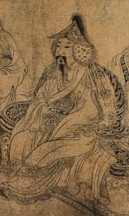
Toghon Temür
ᠲᠣᠭᠤᠨᠲᠡᠮᠦᠷ
Emperor of the Yuan dynasty · Khagan of the Mongols
1320 – 1370
- Born
- 1320
- Died
- 1370
- Reign
- 1333 – 1368
- House
- Mongol Empire
Biography
The last Yuan emperor to rule from China, Toghon Temür (1320-1370) reigned from 1333 until the dynasty's expulsion in 1368, presiding over the collapse of Mongol power in East Asia a century and a half after his ancestor Genghis Khan had united the steppe. He was a descendant of Kublai Khan in the Toluid line — the branch of the Chinggisid family that had held China while its cousins ruled the Golden Horde, the Chagatai ulus, and, until its recent disintegration, the Ilkhanate in Persia.
His path to the throne ran through the murderous succession politics of the late Yuan court. A son of the emperor Khoshila, who died suddenly in 1329 amid a disputed succession, the boy was exiled first to an island off Korea and then to Guangxi in the far south. After the deaths of his uncle Tugh Temür and his own younger brother, court factions enthroned him in 1333 at the age of thirteen. Real power lay for years with chancellors: first the conservative Bayan of the Merkit, who excluded Chinese from office and dominated the government until his nephew Toqto'a engineered his dismissal in 1340, and then Toqto'a himself, who restored the examination system and compiled the official histories of the Liao, Jin, and Song dynasties.
The dynasty's foundations were eroding. Repeated Yellow River floods, famine, epidemic disease, and the inflation of the paper currency bred desperation, and the vast river-rechanneling project of 1351, though an engineering success, concentrated discontented laborers whose risings fed the Red Turban rebellions. Toqto'a's dismissal in 1354, while leading the campaign against the rebels, removed the court's most capable figure. In the following decade the emperor withdrew increasingly from government, the court split between factions aligned with the empress and the crown prince, and regional commanders fought one another while rebel states grew in the south.
Zhu Yuanzhang, the strongest of the rebel leaders, proclaimed the Ming dynasty in 1368 and sent his armies north. Toghon Temür abandoned the capital of Dadu without a battle that year, withdrawing first to Shangdu and then onto the Mongolian steppe, where he died at Yingchang in 1370. His successors maintained the Northern Yuan in Mongolia, still claiming the Chinggisid imperial title long after China itself was lost.
Updated June 2026 · How we research
Events
The Yuan dynasty, founded by Kublai Khan as the Chinese state of the Mongol imperial house, unraveled during the long reign of Toghon Temür, its last emperor to rule from China. From the 1340s the dynasty faced catastrophic Yellow River floods, famine, debased paper currency, and factional purges at court that consumed its ablest ministers. The Red Turban risings that broke out in 1351 fragmented central control over the Yangzi valley, and by the 1360s real power in north China itself lay with semi-independent warlords nominally loyal to the throne, while the court was divided by a succession struggle around the crown prince. Among the southern rebel leaders, Zhu Yuanzhang, a former peasant and sometime Buddhist novice who had risen through a Red Turban army, eliminated his major rivals in the 1360s, defeating Chen Youliang at the lake battle of Poyang in 1363 and extinguishing Zhang Shicheng's state at Suzhou in 1367. Master of the Yangzi valley, he proclaimed the Ming dynasty at Nanjing in January 1368, taking the reign name Hongwu, and dispatched his general Xu Da on a northern expedition. The Ming advance through Shandong and Henan met little coordinated resistance. In September 1368, as the army approached Dadu (modern Beijing), Toghon Temür left the capital with his court and fled north through the passes to Shangdu, and the city fell without a siege. The emperor died in 1370 at Yingchang on the steppe margin. His successors maintained the Yuan imperial title in Mongolia, a polity historians call the Northern Yuan, and the Ming would campaign against it for decades. In Chinese dynastic terms, however, 1368 marks the transfer of the Mandate: the end of a century of Mongol rule and the founding of a native dynasty that held China until 1644.
Also there: Hongwu Emperor (Zhu Yuanzhang)
Connections across houses
Place Toghon Temür in the wider world of ruling houses.
Recommended Reading
Affiliate disclosure: the links below go to Amazon searches. As an Amazon Associate, Dynastica earns from qualifying purchases.