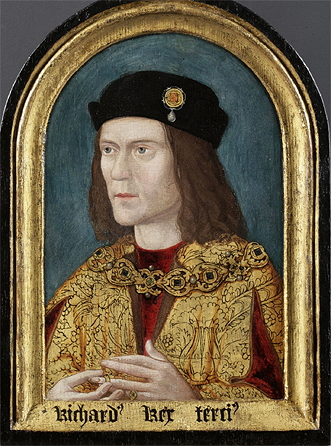
Richard III
Ricardus III
King of England · Lord of Ireland · Duke of Gloucester
1452 – 1485
- Born
- 1452
- Died
- 1485
- Reign
- 1483 – 1485
- House
- Plantagenet
Biography
Richard III was the last king of the House of York and the last of the Plantagenet line. Born in 1452 at Fotheringhay, he was the youngest surviving son of Richard, Duke of York, and Cecily Neville. After his eldest brother won the throne as Edward IV in the Wars of the Roses, Richard was created Duke of Gloucester, fought for Edward at Barnet and Tewkesbury in 1471, and married Anne Neville, younger daughter of Warwick the Kingmaker. Through the 1470s he governed the north of England on his brother's behalf, and in 1482 he led the campaign against Scotland that recovered the border town of Berwick.
Edward IV's death in April 1483 left the twelve-year-old Edward V as king, with Richard named protector. Within months Richard had arrested leading figures of the queen's Woodville family, taken custody of the young king and his brother in the Tower of London, and accepted the throne himself after Edward IV's marriage was declared invalid and his children illegitimate, a settlement later confirmed by parliament in the act Titulus Regius. The two princes disappeared from view during 1483, and their fate, widely attributed to Richard by contemporaries and later writers, remains unresolved.
Richard's short reign was unsettled from the start. A rebellion in the autumn of 1483, nominally led by his former ally the Duke of Buckingham, was suppressed, but many southern gentry fled to join Henry Tudor, the exiled Lancastrian claimant, in Brittany and then France. The death of Richard's only legitimate son, Edward of Middleham, in 1484, followed by that of Queen Anne in early 1485, left the dynasty without a direct heir. His parliament nonetheless enacted measures on bail and legal procedure that were remembered favourably.
In August 1485 Henry Tudor landed in Wales with French backing and met the royal army at Bosworth Field on 22 August. Deserted by key supporters during the battle, Richard was killed fighting, the last English king to die in battle. Henry took the throne as Henry VII and married Richard's niece Elizabeth of York. Richard's remains, long thought lost, were identified beneath a Leicester car park in 2012 and reburied in Leicester Cathedral in 2015.
Updated June 2026 · How we research
Events
Thirty-two years of intermittent civil war between the Lancastrian and Yorkist branches of the Plantagenet dynasty, triggered by the recurring incapacity of Henry VI and the rival claim of Richard, Duke of York. The conflict produced six battles in the 1450s–1460s, the murderous reign of Edward IV, the disappearance of his sons in the Tower, and the final defeat of Richard III at Bosworth in 1485. Resolved by the marriage of Henry VII and Elizabeth of York the following year.
Also there: Henry VI, Margaret of Anjou, Edward IV, Henry VII
On 22 August 1485, Henry Tudor's army of perhaps five thousand met Richard III's larger royal force on Ambion Hill in Leicestershire. The crucial defection of the Stanleys mid-battle, and Richard's reckless personal charge in an attempt to kill Henry himself, decided the outcome. Richard III became the last English king to die in battle; Henry VII was crowned on the field. The Plantagenet dynasty ended on the same hour the Tudor dynasty began.
Also there: Henry VII
Connections across houses
Place Richard III in the wider world of ruling houses.
Recommended Reading
Affiliate disclosure: the links below go to Amazon searches. As an Amazon Associate, Dynastica earns from qualifying purchases.