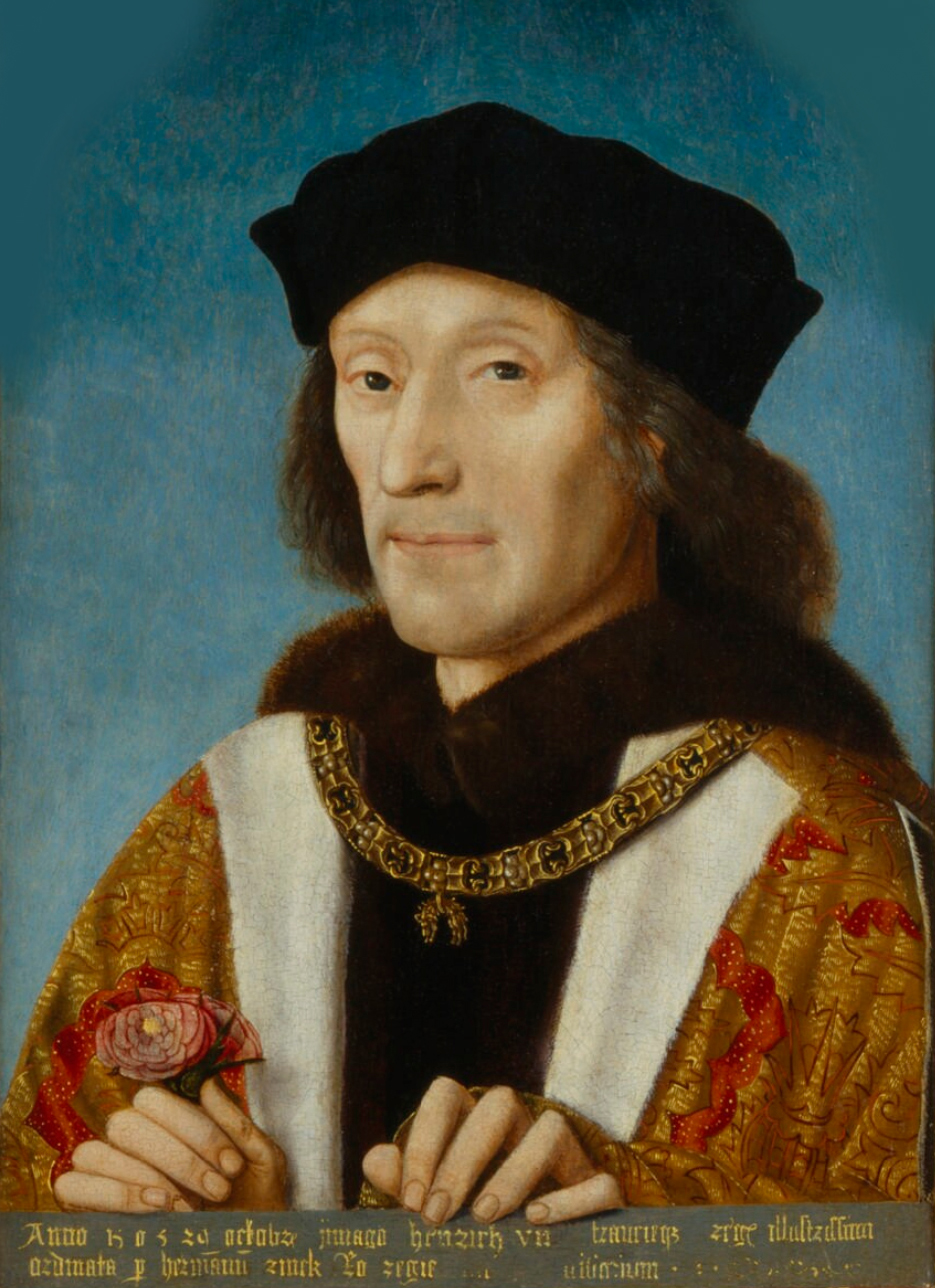
Henry VII
Henricus VII
King of England · Lord of Ireland · Earl of Richmond
1457 – 1509
- Born
- 1457
- Died
- 1509
- Reign
- 1485 – 1509
- House
- Tudor
Biography
The first monarch of the house of Tudor, Henry VII won the English crown by conquest at the battle of Bosworth Field in August 1485, where his forces defeated and killed Richard III. Born in 1457 at Pembroke Castle, he was the only child of Edmund Tudor, Earl of Richmond, and Margaret Beaufort, through whom he inherited a Lancastrian claim to the throne descended from John of Gaunt. He spent fourteen years of his youth in exile in Brittany and France while the house of York held power in England.
In January 1486 Henry married Elizabeth of York, daughter of Edward IV, a union intended to reconcile the rival claims of Lancaster and York after decades of intermittent civil war. The marriage produced several children, including Arthur, Prince of Wales, the future Henry VIII, and Margaret and Mary Tudor. His early reign was troubled by Yorkist conspiracies centred on the pretenders Lambert Simnel, defeated at Stoke in 1487, and Perkin Warbeck, who was eventually captured and executed.
Henry's foreign policy relied on dynastic marriage rather than war. By the Treaty of Medina del Campo he arranged the marriage of Prince Arthur to Catherine of Aragon, daughter of Ferdinand II of Aragon and Isabella I of Castile, binding England to the rising power of Spain; the wedding took place in 1501, though Arthur died only months later. The Treaty of Perpetual Peace with Scotland in 1502 was sealed by the marriage of his daughter Margaret to James IV of the house of Stewart, a connection that a century later brought the Stuart line to the English throne. His younger daughter Mary was later married into the French royal house as queen of Louis XII.
At home Henry worked to restore royal finances and curb the independent power of the nobility. He extended the use of bonds and recognizances to enforce loyalty, developed conciliar justice, and left the crown solvent, though the fiscal methods of his agents Richard Empson and Edmund Dudley made his later years unpopular. His wife Elizabeth died in 1503, and he did not remarry. Henry died at Richmond Palace on 21 April 1509 and was buried in the chapel he had built at Westminster Abbey. He was succeeded without challenge by his surviving son, Henry VIII, the first undisputed succession in England in nearly a century.
Updated June 2026 · How we research
Events
Thirty-two years of intermittent civil war between the Lancastrian and Yorkist branches of the Plantagenet dynasty, triggered by the recurring incapacity of Henry VI and the rival claim of Richard, Duke of York. The conflict produced six battles in the 1450s–1460s, the murderous reign of Edward IV, the disappearance of his sons in the Tower, and the final defeat of Richard III at Bosworth in 1485. Resolved by the marriage of Henry VII and Elizabeth of York the following year.
Also there: Henry VI, Margaret of Anjou, Edward IV, Richard III
On 22 August 1485, Henry Tudor's army of perhaps five thousand met Richard III's larger royal force on Ambion Hill in Leicestershire. The crucial defection of the Stanleys mid-battle, and Richard's reckless personal charge in an attempt to kill Henry himself, decided the outcome. Richard III became the last English king to die in battle; Henry VII was crowned on the field. The Plantagenet dynasty ended on the same hour the Tudor dynasty began.
Also there: Richard III
On 18 January 1486 Henry Tudor married Elizabeth of York, eldest surviving daughter of Edward IV, in Westminster Abbey. The match fused the warring Lancastrian and Yorkist branches of the Plantagenet house, ending the Wars of the Roses by dynastic union rather than continued bloodshed. Their grandson Henry VIII would be the result; through their granddaughter Margaret, the union also transmitted the English crown to the Stuart line a century later.
Also there: Elizabeth of York
Connections across houses
Where Henry VII's family tree leaves the Tudor and enters other ruling houses.
Recommended Reading
Affiliate disclosure: the links below go to Amazon searches. As an Amazon Associate, Dynastica earns from qualifying purchases.