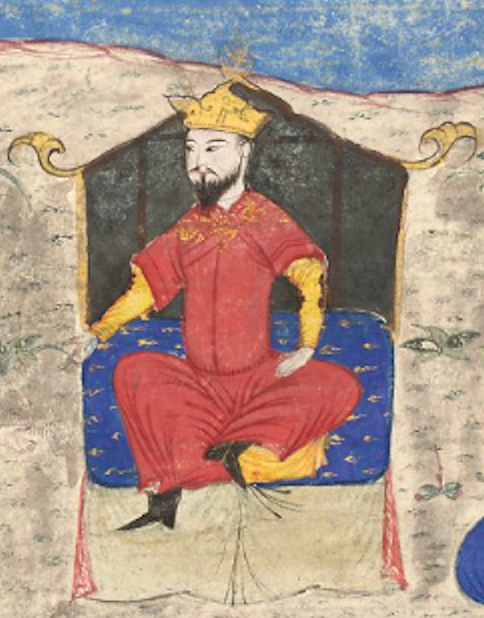
Alp Arslan
Sultan of the Great Seljuk Empire
1029 – 1072
- Born
- 1029
- Died
- 1072
- Reign
- 1063 – 1072
- House
- Seljuk Dynasty
Biography
Muhammad ibn Chaghri, known to history by his Turkish honorific Alp Arslan, "Heroic Lion," inherited the Seljuk east from his father and the sultanate from his uncle. Tughril's death in 1063 opened a contested succession, and Alp Arslan secured the throne by defeating his kinsman Qutalmish in battle — a victory with a long shadow, since Qutalmish's son Suleiman would later found the Sultanate of Rum in Anatolia. From the outset he governed in partnership with the Persian vizier Nizam al-Mulk, whose administrative genius freed the sultan for what he did best, which was war.
His campaigns ranged across the empire's western arc. In 1064 he took Ani, the fortified Armenian cathedral city, and reduced much of the Caucasus to tribute; later expeditions pressed into Syria, where Aleppo acknowledged his suzerainty. His strategic priority, however, was not Byzantium but Fatimid Egypt, the Shia rival to the caliphate he protected. The Anatolian frontier was left largely to Turkmen bands whose raids provoked Constantinople into a massive response.
That response ended at Manzikert, north of Lake Van, on 26 August 1071. The emperor Romanos IV Diogenes had marched east with a large but uneven army to destroy Seljuk power in Armenia; Alp Arslan, breaking off his Syrian campaign, met him with a smaller, faster force. Feigned retreats and a defection in the Byzantine rear turned the battle into a rout, and Romanos was brought captive before the sultan — the only Byzantine emperor ever taken prisoner by a Muslim ruler in battle. Alp Arslan treated him with studied courtesy, concluded a moderate treaty, and released him within days. The moderation proved irrelevant: Romanos was blinded and destroyed by his own court, the treaty died with his government, and the civil wars that followed left Anatolia open to Turkmen migration on a scale no one had planned.
Alp Arslan did not live to see the consequences. Campaigning beyond the Oxus in late 1072, he was fatally stabbed by Yusuf al-Khwarazmi, a captured fortress commander brought before him for judgment, and died within days, about forty-three years old. He had designated his son Malik-Shah as heir, and Nizam al-Mulk ensured the succession held. His nine-year reign had redrawn the map of the Near East at a single battle's stroke.
Updated June 2026 · How we research
Events
- Conflict
Battle of Manzikert
1071· as Victorious commander; captured and released the Byzantine emperorIn August 1071 the Seljuk sultan Alp Arslan met a large Byzantine field army near Manzikert, north of Lake Van, in what is now eastern Turkey. The emperor Romanos IV Diogenes had marched east to recover fortresses on the Armenian frontier and to check the raids that Turkmen bands had been pressing into Anatolia for two decades. Alp Arslan, who had been campaigning toward Fatimid Syria, turned back to meet him and offered terms; Romanos refused. The battle itself, fought on 26 August, ended in a Byzantine collapse. The Seljuk forces used feigned withdrawals to draw the imperial line forward over the course of the day, and when Romanos ordered a retreat at dusk the maneuver dissolved into confusion. The rearguard under Andronikos Doukas, a political rival of the emperor, withdrew from the field rather than cover the retreat, and the imperial center was enveloped. Romanos was wounded and captured, the first Roman emperor taken prisoner by a Muslim ruler in battle. Alp Arslan treated his captive with marked courtesy, concluded a treaty involving tribute and territorial concessions, and released him after about a week. The settlement never took effect: Romanos was overthrown, blinded, and dead within a year, and the treaty died with him. The decade of Byzantine civil war that followed mattered more than the battle's casualties. Rival claimants hired Turkmen war bands and brought them across Anatolia as auxiliaries, and these groups stayed, settled, and carved out lordships. Within twenty years most of the plateau had passed out of imperial control, and a Seljuk principality, the Sultanate of Rum, was established with its eventual seat at Nicaea and later Konya. Manzikert thus opened Anatolia to Turkish settlement less by conquest than by the political disintegration it triggered.
Connections across houses
Place Alp Arslan in the wider world of ruling houses.
Recommended Reading
Affiliate disclosure: the links below go to Amazon searches. As an Amazon Associate, Dynastica earns from qualifying purchases.