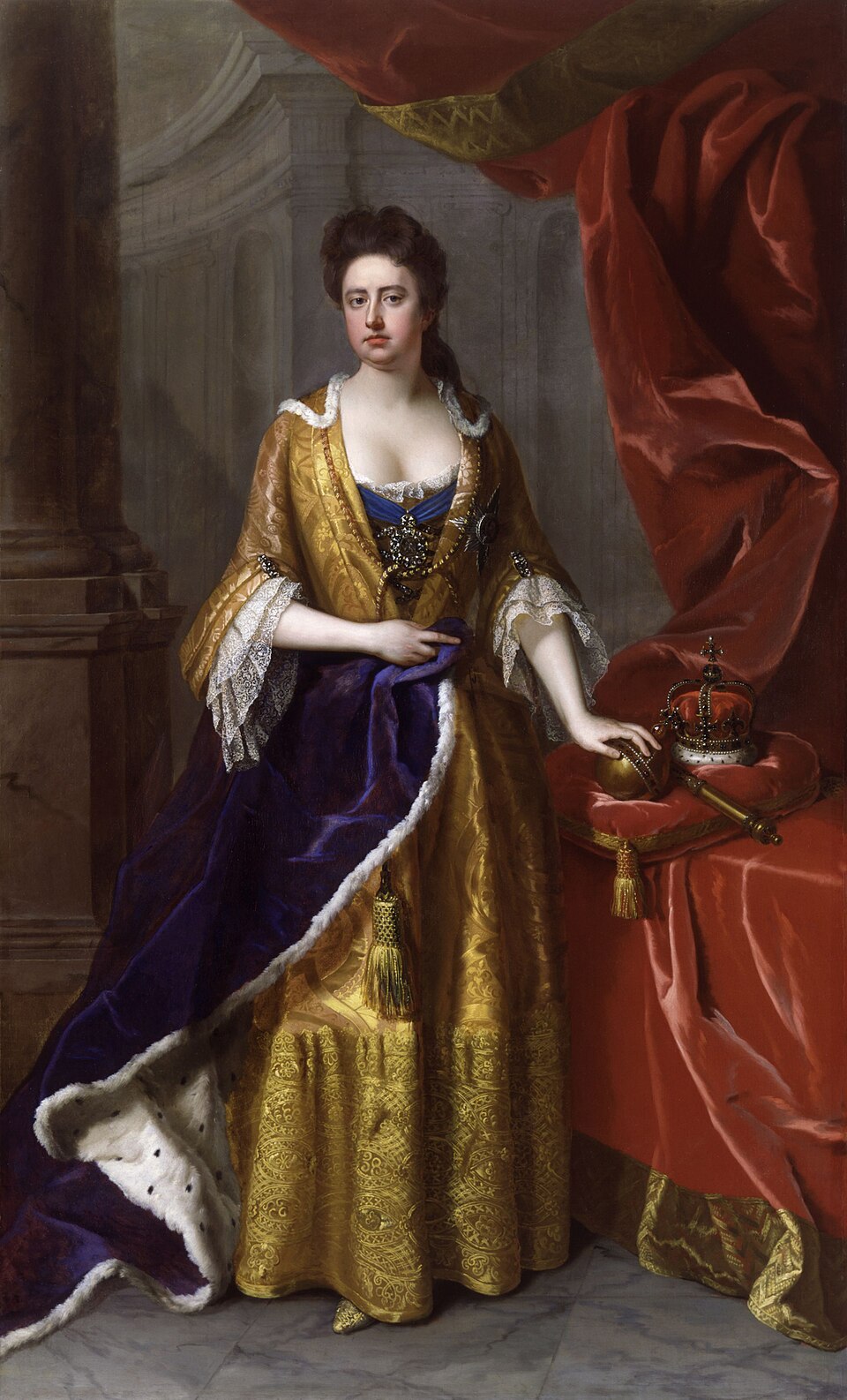
Anne
Anna
Queen of England · Queen of Scotland (until 1707) · Queen of Great Britain · Queen of Ireland
1665 – 1714
- Born
- 1665
- Died
- 1714
- Reign
- 1702 – 1714
- House
- Stuart
Biography
Anne was the last Stuart monarch and the first sovereign of the united Kingdom of Great Britain. Born in February 1665, she was the second daughter of James, Duke of York, later James II, and his first wife Anne Hyde. By royal instruction she and her sister Mary were raised in the Church of England despite their father's Catholicism, and her firm Protestantism shaped her politics. In 1683 she married Prince George of Denmark, a younger son of Frederick III of the Danish house of Oldenburg; the marriage was affectionate but dynastically tragic, for none of Anne's seventeen pregnancies produced a child who survived her, the longest-lived, William, Duke of Gloucester, dying in 1700 at the age of eleven.
During the Revolution of 1688 Anne abandoned her father's cause and supported the invasion of her brother-in-law William of Orange. Under William III and Mary II she stood next in the line of succession, and the death of her son prompted the Act of Settlement of 1701, which directed the crown after her to the Protestant descendants of Sophia of Hanover, granddaughter of James VI and I.
Anne succeeded William in March 1702, days before England entered the War of the Spanish Succession against Bourbon France and Spain. The war brought the celebrated victories of John Churchill, Duke of Marlborough, at Blenheim, Ramillies, and elsewhere, and Marlborough's wife Sarah was for years the queen's closest confidante before their friendship collapsed. The defining constitutional act of the reign was the Union of England and Scotland in 1707, which created a single Parliament of Great Britain.
Plagued by gout and chronic ill health, widowed in 1708, Anne presided in her final years over bitter party conflict between Whigs and Tories and the peace negotiations concluded at Utrecht in 1713. She died on 1 August 1714. In accordance with the Act of Settlement the crown passed over dozens of Catholic claimants to George, Elector of Hanover, her second cousin.
Updated June 2026 · How we research
Events
Parallel Acts passed by the parliaments of England and Scotland in 1706 and 1707 dissolved both legislatures and created a single Kingdom of Great Britain with a unified parliament at Westminster. Scotland retained its distinct legal system, established church, and educational institutions. The union was politically driven (Scotland's financial collapse after the Darien venture, English fears of a separate Stuart restoration) and deeply unpopular in Scotland for generations.
Connections across houses
Place Anne in the wider world of ruling houses.
Recommended Reading
Affiliate disclosure: the links below go to Amazon searches. As an Amazon Associate, Dynastica earns from qualifying purchases.