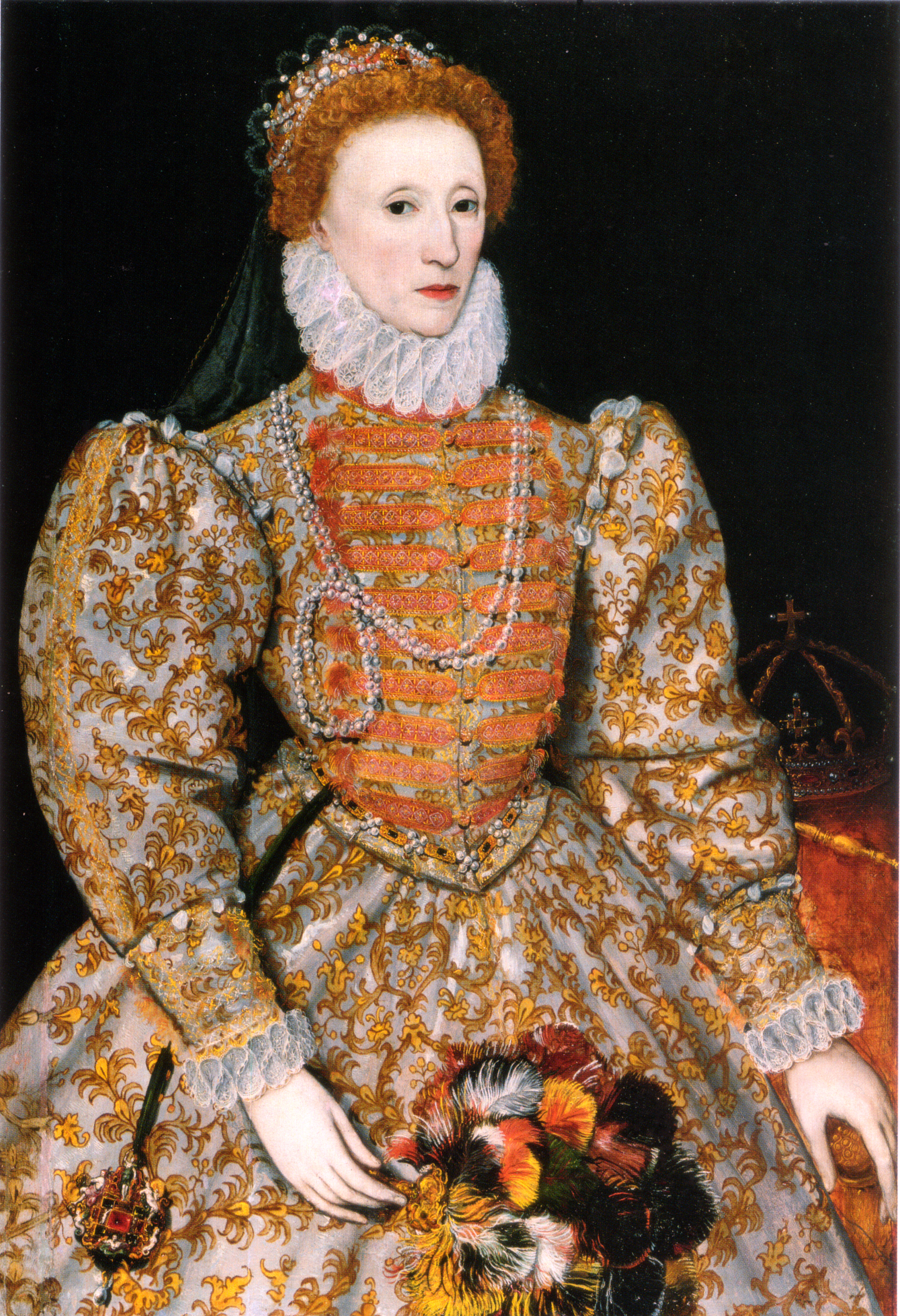
Elizabeth I
Elizabetha I
Queen of England · Queen of Ireland · Supreme Governor of the Church of England
1533 – 1603
- Born
- 1533
- Died
- 1603
- Reign
- 1558 – 1603
- House
- Tudor
Biography
Elizabeth I reigned over England and Ireland for more than four decades, the last monarch of the house of Tudor. Born at Greenwich in September 1533, she was the daughter of Henry VIII and his second wife, Anne Boleyn. Her mother's execution in 1536 was followed by a statute declaring Elizabeth illegitimate, though the succession act of 1544 restored her place in line to the throne after Edward and Mary. She received an exceptional humanist education and was fluent in several languages.
Her position under her Catholic half-sister Mary I was precarious; suspected of complicity in Wyatt's rebellion, she was imprisoned in the Tower of London in 1554 and then held under house arrest, though nothing was proved against her. On Mary's death in November 1558 Elizabeth succeeded peacefully. The religious settlement of 1559, enacted through the Acts of Supremacy and Uniformity, re-established a Protestant national church with the queen as supreme governor, a moderate framework that endured despite pressure from both Catholics and more radical reformers.
Elizabeth never married, despite prolonged negotiations with foreign suitors including Habsburg and French Valois princes, and the succession remained unsettled throughout her reign. The strongest hereditary claim belonged to her cousin Mary, Queen of Scots, of the house of Stuart, a descendant of Henry VII through his daughter Margaret Tudor's marriage to James IV of Scotland. Mary fled to England in 1568 and was held in custody for nineteen years; after repeated Catholic plots in her name, she was executed in 1587 following the Babington conspiracy.
The later reign was dominated by war with Spain. Philip II, once the husband of Mary I, launched the Armada of 1588, which was repulsed by the English fleet and scattered by storms; the Anglo-Spanish war continued at sea and in the Netherlands until after Elizabeth's death. Her government, served by ministers such as William Cecil, Lord Burghley, and Francis Walsingham, also faced prolonged rebellion in Ireland and economic strain in the 1590s. The era nevertheless saw a notable flowering of English literature and overseas enterprise. Elizabeth died at Richmond on 24 March 1603 and was succeeded, by peaceful arrangement, by Mary Stuart's son James VI of Scotland, uniting the English and Scottish crowns in the house of Stuart.
Updated June 2026 · How we research
Events
On 8 February 1587, after nineteen years of English captivity and three botched plots against Elizabeth I in her name, Mary Stuart was beheaded at Fotheringhay Castle. Elizabeth signed the warrant under enormous Privy Council pressure and later professed bitter regret. Mary's son James VI of Scotland — destined to inherit the English throne sixteen years later — protested the execution but did not break with England over it.
Also there: Mary, Queen of Scots
Philip II of Spain assembled the Grande y Felicísima Armada — 130 ships, 30,000 men — to invade Elizabethan England, depose its Protestant queen, and reclaim the English throne for Catholicism. English long-range gunnery, fireships at Calais, and the great Atlantic gales drove the fleet north around Scotland and Ireland; perhaps half the ships and most of the men never returned to Spain. The defeat ended Spain's century-long dominance of European warfare.
Also there: Philip II of Spain
Elizabeth I died childless on 24 March 1603 with the words "my cousin of Scotland" reportedly her last designation of an heir. Her great-grandnephew James VI of Scotland — descended from Henry VII through his daughter Margaret Tudor — inherited the English and Irish crowns the same day, uniting the three British kingdoms under a single monarch for the first time. Each kept its own parliament, courts, and church.
Also there: James VI and I, Margaret Tudor
Connections across houses
Place Elizabeth I in the wider world of ruling houses.
Recommended Reading
Affiliate disclosure: the links below go to Amazon searches. As an Amazon Associate, Dynastica earns from qualifying purchases.