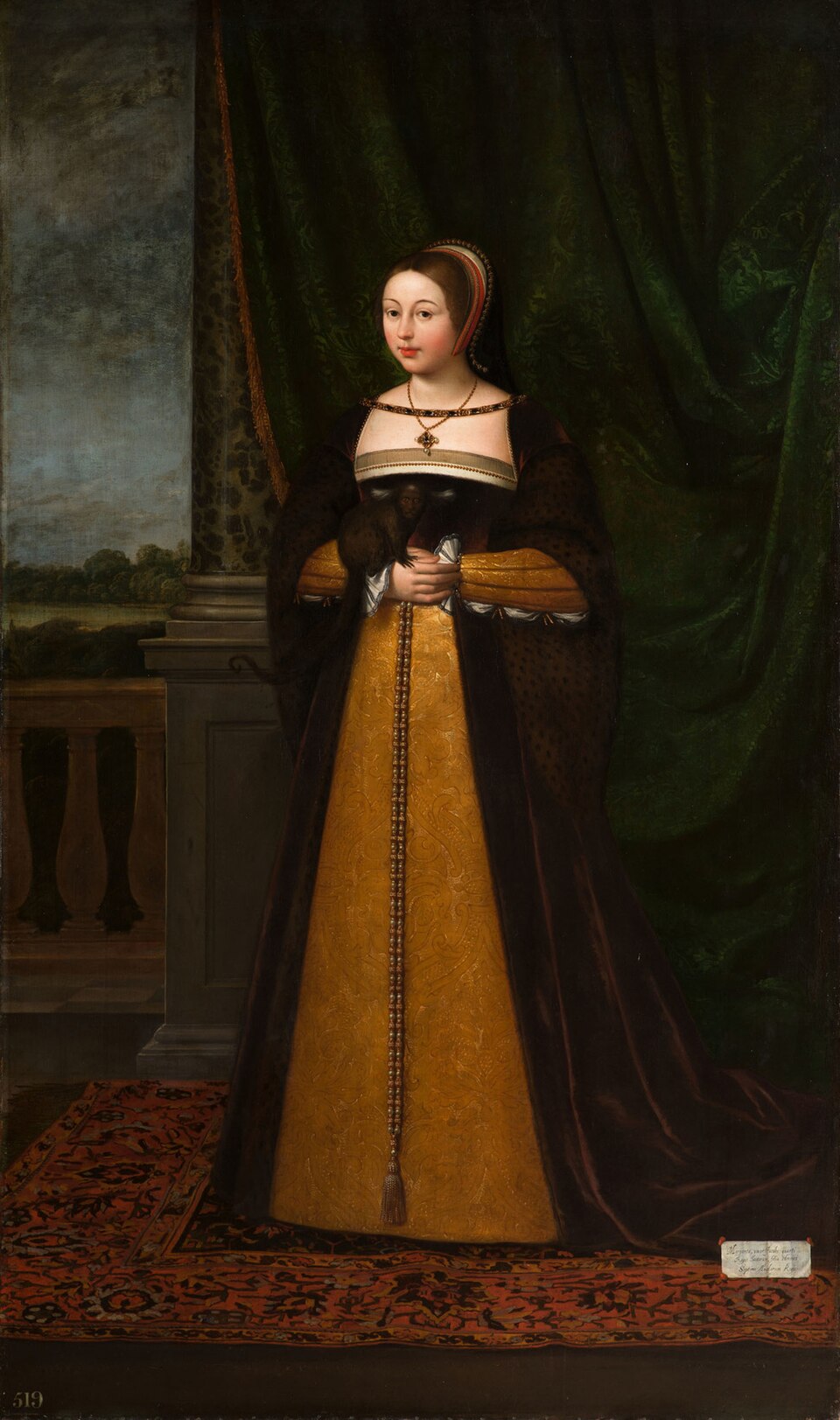
Margaret Tudor
Margaret Tudor
Queen of Scotland · Princess of England
1489 – 1541
- Born
- 1489
- Died
- 1541
- House
- Tudor
Biography
As the eldest daughter of Henry VII and Elizabeth of York, Margaret Tudor was an instrument of her father's diplomacy almost from birth. Born at Westminster on 28 November 1489, she was promised to James IV of Scotland under the Treaty of Perpetual Peace of 1502, which sought to end generations of Anglo-Scottish warfare. The marriage, celebrated at Holyroodhouse on 8 August 1503, joined the houses of Tudor and Stewart and was commemorated as the union of the Thistle and the Rose.
Margaret bore James six children, of whom only one, the future James V, survived infancy. The peace her marriage embodied did not hold: in 1513 James IV invaded England in support of France and was killed at Flodden. His will named Margaret regent for their infant son so long as she remained a widow. Her position collapsed in 1514 when she married Archibald Douglas, sixth Earl of Angus; the regency passed to John Stewart, Duke of Albany, and Margaret spent the following years navigating the unstable factional politics of Scotland, at times in exile in England at the court of her brother, Henry VIII.
Her second marriage produced a daughter, Margaret Douglas, later Countess of Lennox, but ended in estrangement; a papal annulment was granted in 1527. The following year she married Henry Stewart, Lord Methven, and in the same period her son James V escaped the custody of Angus and began his personal rule. Margaret remained intermittently influential at the Scottish court, often attempting to promote better relations between her son and her brother. She died at Methven Castle on 18 October 1541 and was buried in Perth.
Margaret's descendants determined the future of both kingdoms. Through James V she was grandmother of Mary, Queen of Scots; through Margaret Douglas she was grandmother of Henry, Lord Darnley, Mary's husband. Their son, James VI of Scotland, united both lines of descent from her, and his accession to the English throne in 1603 as James I rested on the claim transmitted through Margaret — the Tudor-Stewart connection her marriage had created exactly a century before.
Updated June 2026 · How we research
Events
In 1513 Henry VIII of England joined the Holy League against France and crossed the Channel to campaign in Picardy. James IV of Scotland, bound to France by the renewed Auld Alliance and to England by the 1502 Treaty of Perpetual Peace and his marriage to Henry's sister Margaret Tudor, honored the French connection. In August he led the largest army a Scottish king had ever taken across the border, equipped with modern artillery and continental pike tactics, and took the Norham and Ford castles in Northumberland. The English response was commanded by Thomas Howard, earl of Surrey, the veteran lieutenant left to guard the north. By a flanking march Surrey placed his army between the Scots and Scotland, and on 9 September 1513 the battle was fought near the village of Branxton. The Scottish pike columns advanced downhill across ground broken by a concealed marsh; their formations lost cohesion, and in the close fighting English bills outmatched the long pikes. James fought on foot in the leading division and was killed within reach of Surrey's standard. With him died a remarkable proportion of the Scottish leadership: contemporary accounts count an archbishop, bishops and abbots, around a dozen earls, and many lords and lairds, along with thousands of common soldiers. It remains the heaviest defeat in Scottish military history. The crown passed to James V, seventeen months old. Margaret Tudor, the widowed queen, became regent under the terms of her husband's will, the first of several unstable regencies of a long minority; she lost the office on her remarriage in 1514, and Scottish politics for the next generation turned on the contest between pro-French and pro-English factions. Henry VIII, for whom Flodden was won in absentia, gained security on his northern border but pressed no conquest of Scotland.
Also there: James IV of Scotland, Henry VIII
Elizabeth I died childless on 24 March 1603 with the words "my cousin of Scotland" reportedly her last designation of an heir. Her great-grandnephew James VI of Scotland — descended from Henry VII through his daughter Margaret Tudor — inherited the English and Irish crowns the same day, uniting the three British kingdoms under a single monarch for the first time. Each kept its own parliament, courts, and church.
Also there: Elizabeth I, James VI and I
Connections across houses
Where Margaret Tudor's family tree leaves the Tudor and enters other ruling houses.
Recommended Reading
Affiliate disclosure: the links below go to Amazon searches. As an Amazon Associate, Dynastica earns from qualifying purchases.