Conflict·b. 1526
Battle of Mohács
Overview
On 29 August 1526 the Ottoman army under Süleyman I destroyed the army of the Kingdom of Hungary on the plain of Mohács, near the Danube in the country's south. Süleyman had opened the road in 1521 by taking Belgrade, the key fortress of Hungary's southern defenses, and marched north in 1526 with a large, artillery-rich force. The young king Louis II, who ruled both Hungary and Bohemia, met him with an army of roughly 25,000, assembled hastily and without the substantial contingents of Transylvania under John Zápolya and of Croatia, which had not arrived.
The battle lasted only a few hours. Hungarian heavy cavalry charges achieved initial momentum but broke against the Ottoman center, where chained guns and janissary volleys shattered the attack, and the army disintegrated. Most of the Hungarian high command, including both archbishops and a large part of the episcopate and baronage, died on the field or in the rout. Louis II drowned in a swollen stream during the flight, leaving no legitimate heir. Süleyman occupied and burned Buda but withdrew that autumn without garrisoning central Hungary.
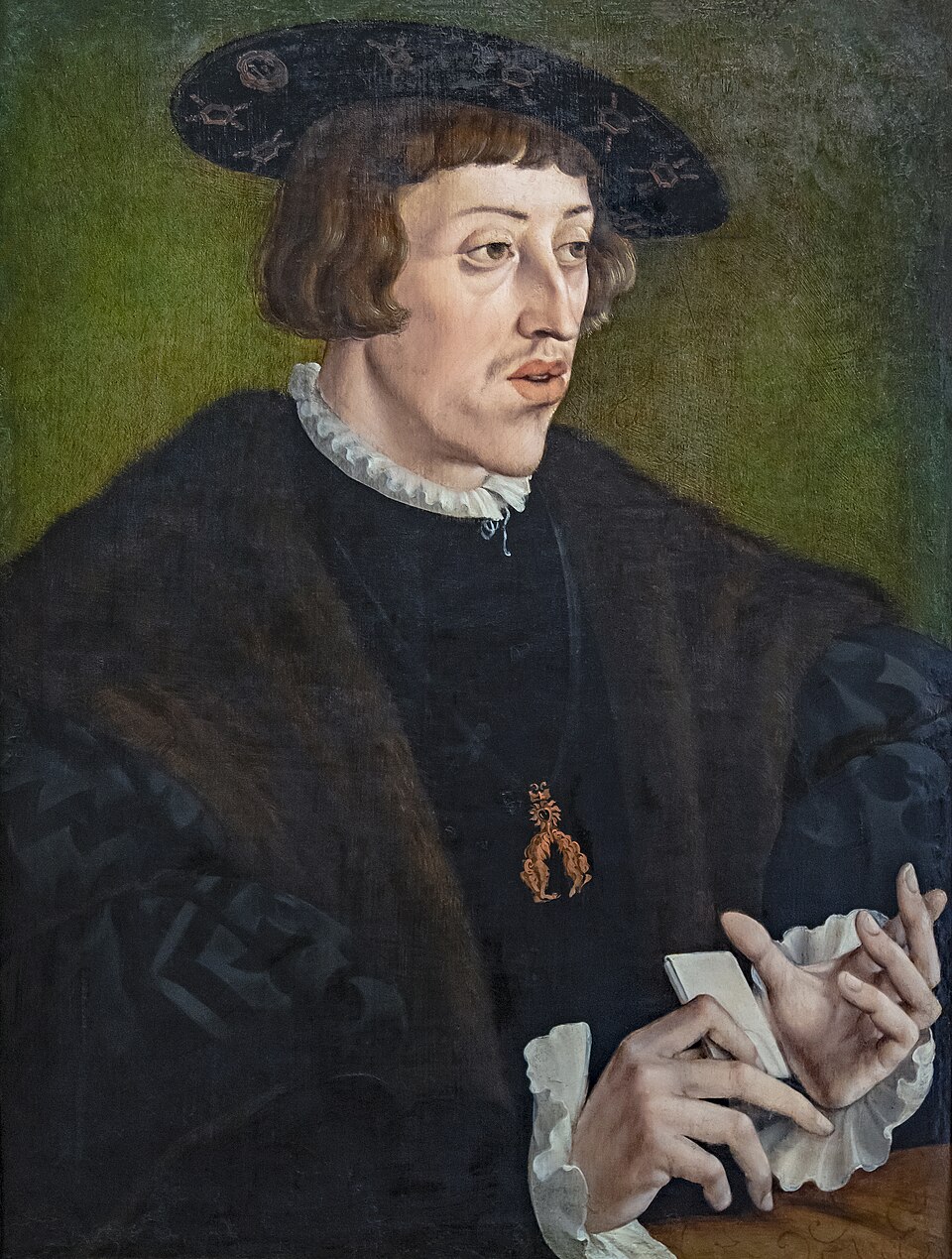
The succession crisis proved as consequential as the battle. By treaties of 1515 between the Habsburgs and the Jagiellonians, and through his marriage to Louis's sister Anna, Ferdinand I of Habsburg, brother of the emperor Charles V, claimed the vacant crowns. He was elected king of Bohemia in October 1526, while in Hungary rival diets elected both Ferdinand and John Zápolya, beginning a civil war that ended with the country partitioned among Habsburg "Royal Hungary," the Ottoman-held center after 1541, and an Ottoman-vassal principality in Transylvania. The Habsburg acquisition of the Bohemian and Hungarian crowns in 1526 assembled the Danubian composite monarchy that the dynasty would rule until 1918.
Figures
Events of the era
- Spanish Conquest of Tenochtitlan1519 – 1521
- English Reformationb. 1534
- Battle of Floddenb. 1513
- Marriage of Mary I and Philip II of Spainb. 1554
- Abdication of Charles Vb. 1556