Gurandukht of Abkhazia
Queen Consort of Iberia · Princess of Abkhazia
- House
- Abkhazia
Biography
Gurandukht of Abkhazia was the dynastic hinge on which the unification of Georgia turned. A daughter of King George II of Abkhazia, she was the sister of the last three kings of the house of Leon, Leon III, Demetrius III, and Theodosius III, none of whom left a son. Her marriage to Gurgen, heir of the Bagratid line of northern Tao and son of Bagrat II, "the Simple," joined the Abkhazian royal house to the Bagrationi, and their only known son, Bagrat, born around 960, became heir to both. When the Abkhazian nobility, led by Ioane Marushisdze, sought a strong ruler about 978, it was through his mother that Bagrat was invested with the crown of Abkhazia, and by inheriting his father's and his adoptive father's Bagratid lands he went on to become Bagrat III, the first king of a united Georgia.
Gurandukht was a ruler in her own right. When David III Kuropalates of Tao installed the boy Bagrat in Kartli in 975, she and Gurgen governed there as regents, and the Chronicle of Kartli says she held the country for a considerable time, administering the rock-hewn fortress town of Uplistsikhe while her son was occupied in the west. The relationship was not always smooth: the chronicle records that the Kartlian nobles remained loyal to her rather than to the young king, that Bagrat defeated them at Moghrisi and took Uplistsikhe from his mother, and that he then carried her off with him to Abkhazia. An Armenian inscription at Ateni Sioni, cut between 982 and 986, adds that the mother of the Abkhazian king had joined a conspiracy against her son.
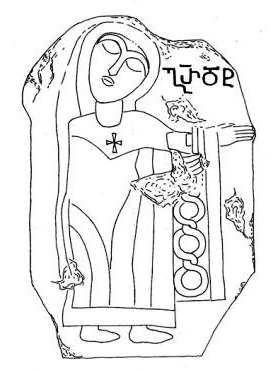
Reconciliation followed, and Bagrat made a point of honoring the descent that legitimized him. Gurandukht appears beside him, styled queen mother, in the building inscription of the Bagrati cathedral at Kutaisi and on the gold chalice presented to Bedia, the cathedral in Abkhazia that the two of them completed in 999 and where Bagrat was later buried. Several scholars identify a female figure carved at Kumurdo as her portrait, though the identification is not certain. The date of her death is unknown; an inscription of Bagrat III from 1002 already refers to her as departed, and her burial place is not recorded.
Updated September 2026 · How we research
Connections across houses
Where Gurandukht of Abkhazia's family tree leaves the Abkhazia and enters other ruling houses.
Recommended Reading
Affiliate disclosure: the links below go to Amazon searches. As an Amazon Associate, Dynastica earns from qualifying purchases.