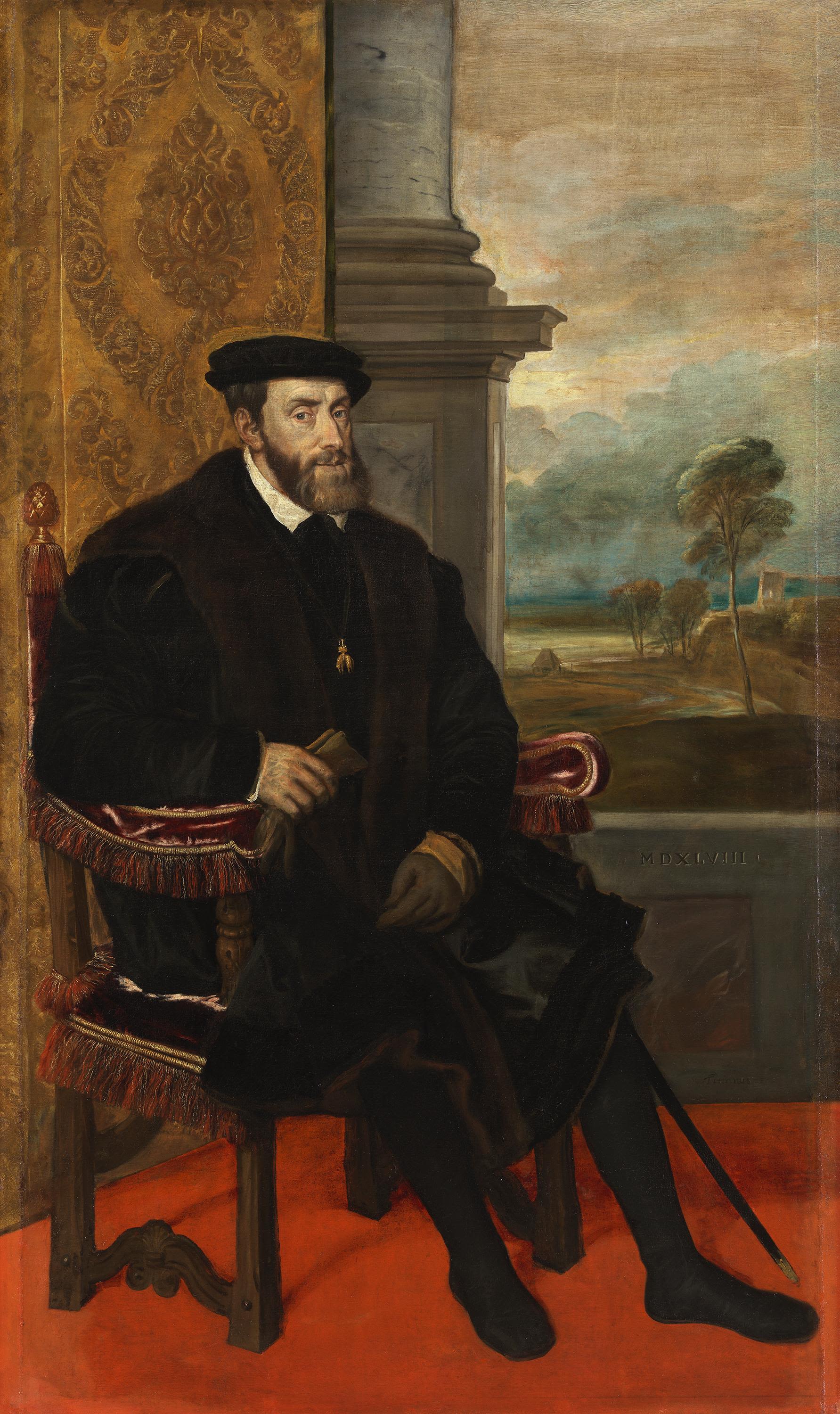
Charles V
Holy Roman Emperor · King of Spain · Archduke of Austria
1500 – 1558
- Born
- 1500
- Died
- 1558
- House
- Spanish Habsburgs
Biography
Charles V (1500-1558) ruled an accumulation of territories larger than that of any European monarch since Charlemagne, assembled almost entirely by inheritance. Born at Ghent, he was the eldest son of Philip the Handsome and Juana of Castile, and thus the grandson of Maximilian I and Mary of Burgundy on one side and of Ferdinand of Aragon and Isabella of Castile on the other. His father's death in 1506 made him duke of the Burgundian Netherlands, where he was raised under the guardianship of his aunt Margaret of Austria; the death of Ferdinand of Aragon in 1516 brought him Castile and Aragon, with Naples, Sicily, Sardinia, and the expanding American possessions, ruling nominally with his confined mother. When Maximilian died in 1519, Charles inherited the Austrian lands and was elected Holy Roman Emperor over the rival candidacy of Francis I of France.
The scale of the inheritance dictated its problems. By the treaties of Worms and Brussels (1521-1522) Charles transferred the Austrian territories to his younger brother Ferdinand, who became his lieutenant in the Empire and, through his Jagiellon marriage, king of Bohemia and Hungary from 1526 — the origin of the Austrian branch of the house. Charles himself fought four wars against Francis I over Italy and Burgundy, capturing the French king at Pavia in 1525, and confronted Ottoman expansion under Suleiman, whose forces besieged Ferdinand's Vienna in 1529; Charles led the capture of Tunis in 1535.
The Reformation defined his reign in Germany. He presided over the Diet of Worms in 1521, where Luther refused to recant, and after decades of inconclusive negotiation defeated the Protestant Schmalkaldic League at Mühlberg in 1547. The victory proved unusable: a princely revolt in 1552 forced him to accept the religious settlement concluded by Ferdinand at Augsburg in 1555, which recognized Lutheranism within the Empire.
In 1526 Charles married Isabella of Portugal, a union that strengthened the Iberian orientation of his line; their son Philip was raised as a Spanish prince. Exhausted and afflicted by gout, Charles abdicated in stages in 1555-1556, leaving Spain, the Netherlands, and Italy to Philip II and the imperial office to Ferdinand I, formalizing the division between Spanish and Austrian Habsburgs. He retired to a house adjoining the monastery of Yuste in Extremadura, where he died on 21 September 1558.
Updated June 2026 · How we research
Events
- Conflict
Spanish Conquest of Tenochtitlan
1519 – 1521· as Habsburg monarch who authorized the conquestA two-year campaign by Hernán Cortés and roughly six hundred Spaniards, aided by smallpox and tens of thousands of indigenous allies who hated Mexica rule, destroyed the Aztec Empire. Moctezuma II received Cortés peacefully in Tenochtitlan in November 1519 and was held captive there; he died in disputed circumstances during the Mexica uprising of 1520. The eighty-day Spanish siege ended on 13 August 1521 with the capture of the last tlatoani, Cuauhtémoc.
Also there: Moctezuma II, Cuitlahuac, Cuauhtémoc
Between 1554 and 1556 Charles V, exhausted by four decades of universal war, partitioned the empire he had inherited intact. His son Philip received Spain, the Indies, the Italian possessions, and the Low Countries; his brother Ferdinand received Austria, Bohemia, Hungary, and ultimately the imperial title. The split divided the Habsburgs into Spanish and Austrian branches that would remain cousin powers for the next century and a half. Charles retired to a monastery in Yuste and died there in 1558.
Also there: Ferdinand I, Philip II of Spain
Connections across houses
Where Charles V's family tree leaves the Spanish Habsburgs and enters other ruling houses.
Recommended Reading
Affiliate disclosure: the links below go to Amazon searches. As an Amazon Associate, Dynastica earns from qualifying purchases.