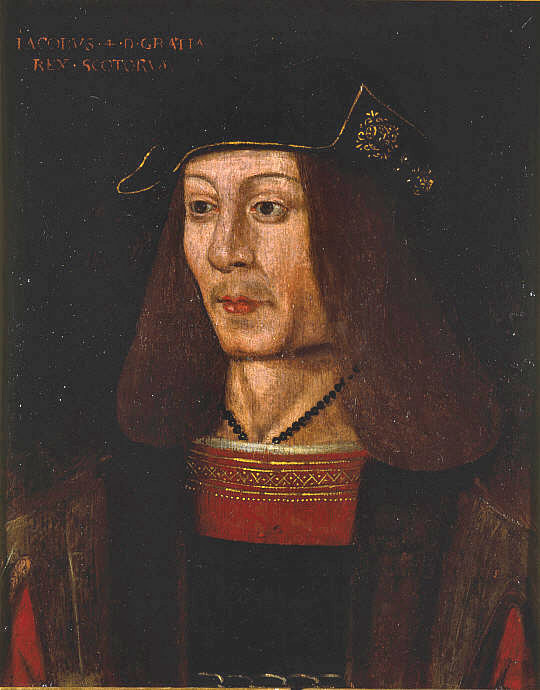
James IV of Scotland
Seumas IV
King of Scots
1473 – 1513
- Born
- 1473
- Died
- 1513
- Reign
- 1488 – 1513
- House
- Stuart
Biography
James IV came to the Scottish throne in 1488 through a rebellion against his own father. Born on 17 March 1473, the eldest son of James III and Margaret of Denmark — a daughter of Christian I of Denmark, whose dowry had brought Orkney and Shetland to Scotland — he was fifteen when discontented nobles made him the figurehead of a rising that ended with James III's death after the Battle of Sauchieburn in June 1488. According to tradition the new king wore an iron belt in penance for his part in the affair for the rest of his life.
His reign is generally counted the most successful of the Stewart line. James imposed royal authority on the Highlands and Isles, suppressing the Lordship of the Isles, and governed without recourse to the long minorities and factional collapses that marked the reigns around his. His court reflected Renaissance tastes: the Education Act of 1496 required schooling for the sons of barons, the kingdom's first printing press was licensed in 1507, a college of surgeons was chartered in Edinburgh, and the king built a navy whose flagship, the Great Michael, was among the largest warships of its day.
In foreign policy James first sponsored the pretender Perkin Warbeck against Henry VII, then reversed course. The Treaty of Perpetual Peace of 1502 and his marriage to Margaret Tudor, Henry VII's daughter, at Holyroodhouse in August 1503 bound the Stewarts to the new Tudor dynasty — a union of the Thistle and the Rose from which the later Stuart claim to England descended. Of the couple's children, only the future James V survived infancy.
The peace failed under James's continuing commitment to the Auld Alliance with France. When Henry VIII invaded France in 1513, James crossed the border with a large army and met an English force under the Earl of Surrey at Flodden on 9 September 1513. The battle was a catastrophe: the king was killed along with a substantial part of the Scottish nobility, the last monarch in Britain to die in battle. He was succeeded by his son James V, an infant of seventeen months.
Updated June 2026 · How we research
Events
In 1513 Henry VIII of England joined the Holy League against France and crossed the Channel to campaign in Picardy. James IV of Scotland, bound to France by the renewed Auld Alliance and to England by the 1502 Treaty of Perpetual Peace and his marriage to Henry's sister Margaret Tudor, honored the French connection. In August he led the largest army a Scottish king had ever taken across the border, equipped with modern artillery and continental pike tactics, and took the Norham and Ford castles in Northumberland. The English response was commanded by Thomas Howard, earl of Surrey, the veteran lieutenant left to guard the north. By a flanking march Surrey placed his army between the Scots and Scotland, and on 9 September 1513 the battle was fought near the village of Branxton. The Scottish pike columns advanced downhill across ground broken by a concealed marsh; their formations lost cohesion, and in the close fighting English bills outmatched the long pikes. James fought on foot in the leading division and was killed within reach of Surrey's standard. With him died a remarkable proportion of the Scottish leadership: contemporary accounts count an archbishop, bishops and abbots, around a dozen earls, and many lords and lairds, along with thousands of common soldiers. It remains the heaviest defeat in Scottish military history. The crown passed to James V, seventeen months old. Margaret Tudor, the widowed queen, became regent under the terms of her husband's will, the first of several unstable regencies of a long minority; she lost the office on her remarriage in 1514, and Scottish politics for the next generation turned on the contest between pro-French and pro-English factions. Henry VIII, for whom Flodden was won in absentia, gained security on his northern border but pressed no conquest of Scotland.
Also there: Henry VIII, Margaret Tudor
Connections across houses
Where James IV of Scotland's family tree leaves the Stuart and enters other ruling houses.
Recommended Reading
Affiliate disclosure: the links below go to Amazon searches. As an Amazon Associate, Dynastica earns from qualifying purchases.