Conflict·b. 1260
Battle of Ain Jalut
Overview
The campaign that ended at Ain Jalut began with the westward offensive of Hulagu Khan, brother of the great khan Möngke, who had been charged with subduing the Islamic lands. In 1258 his army sacked Baghdad and put the last reigning Abbasid caliph, al-Musta'sim, to death, extinguishing a caliphate that had stood for five centuries. In early 1260 the Mongols took Aleppo by storm and received the surrender of Damascus. The Ayyubid ruler of Syria, an-Nasir Yusuf, abandoned his capital without a battle, fled south, and was captured; he was later killed in Mongol custody. Ayyubid Syria had ceased to exist as a power.
Hulagu then withdrew the bulk of his army eastward, a movement usually connected to the death of Möngke in 1259 and the succession struggle that followed, though logistical limits on pasturing a large cavalry army in Syria may have weighed as heavily. He left a force of perhaps ten to twenty thousand under the Naiman commander Kitbuqa and sent envoys to Cairo demanding submission. The Mamluk sultan Qutuz executed the envoys and marched into Palestine, joined by the émigré commander Baybars.
The armies met on 3 September 1260 at Ain Jalut, the "Spring of Goliath," in the Jezreel Valley of Galilee. The Mamluks, fielding numbers at least equal to the Mongol force, drew Kitbuqa's troops forward with a feigned retreat and enveloped them; Kitbuqa was captured and executed. The defeat was modest in scale but large in consequence: it was the first major battlefield reverse of the Mongol westward expansion not soon avenged, it fixed the Euphrates as the rough frontier between the Mamluk sultanate and Hulagu's Ilkhanate, and it delivered Muslim Syria to the Mamluks. Qutuz was assassinated on the homeward march, and Baybars took the throne.
Figures
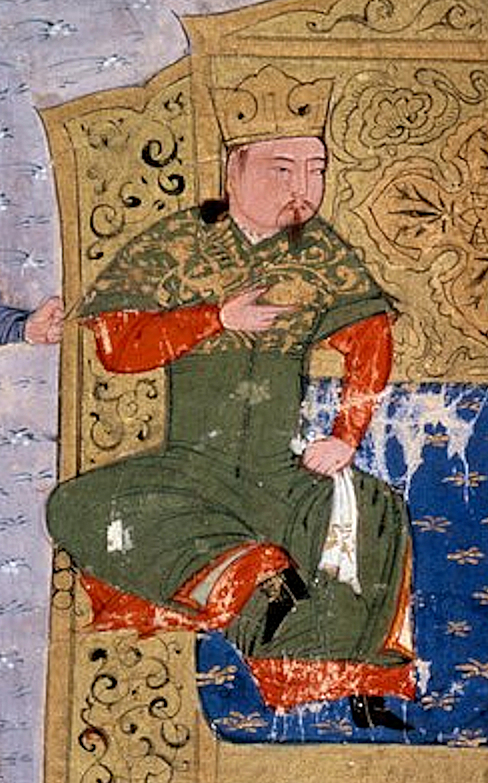
Events of the era
- Sack of Baghdadb. 1258
- Founding of the Yuan Dynastyb. 1271
- Seventh Crusade1248 – 1250
- Treaty of Jaffab. 1229